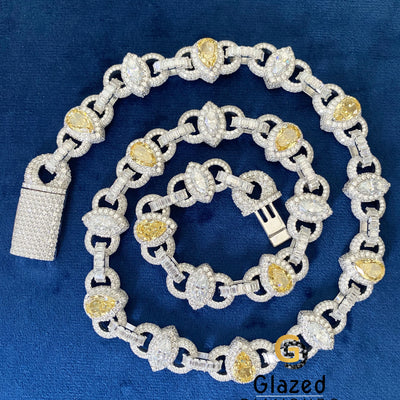

The moissanite marquise cut is one of the most visually dramatic shapes in modern jewelry. It delivers an elongated, boat-shaped silhouette with two sharp pointed ends that elongates the finger and draws attention immediately.
Unlike a round stone, which distributes light evenly in all directions, the marquise concentrates brilliance along a longer and narrower face. The result is a more directed, more theatrical sparkle — and a stone that reads larger than its actual carat weight.
What is a Marquise Cut Stone?
A marquise cut is an elongated gemstone shape with two pointed ends connected by curved sides. It belongs to the fancy cut category, which includes shapes like pear, oval, and heart — all cut differently from the standard round brilliant.
The shape traces its origins to 18th-century France, commissioned by King Louis XV. It later became associated with vintage and Art Deco jewelry traditions, and today it is recognized as one of the most distinctive elongated moissanite cuts available.
A standard marquise moissanite features 58 facets. The length-to-width ratio for the most balanced, classic look falls between 1.85 and 2.10, with a ratio around 2.0 considered the sweet spot for most buyers.
For a broader look at how different shapes perform, the guide to the best cuts for moissanite covers every major shape in detail.
Moissanite Marquise Cut — Sparkle and Light Performance
How Fire Behaves in a Marquise Shape
Moissanite has a refractive index of 2.65 to 2.69, compared to 2.42 for diamond. That higher index means more fire — the colorful, rainbow-like flashes that appear when light hits the stone.
In a marquise shape, that fire travels along the full length of the stone. Flashes appear spread out and elongated rather than concentrated at a center point. Under direct lighting, the effect is vivid and bold.
Buyers who want maximum visual impact at a given carat weight consistently find moissanite sparkle in marquise shape to be a strong performer. The stone reads large, fires brilliantly, and commands attention from across the room.
The Moissanite Bowtie Effect — What to Know
The bowtie effect is a dark shadow that runs horizontally across the center of elongated cuts. It forms when light exits the stone at certain viewing angles rather than reflecting back to the eye.
In natural diamonds, the bowtie can be prominent and distracting. In moissanite, the stone's double refraction and stronger fire significantly reduce the visibility of this effect. A well-cut marquise moissanite stone shows minimal to no visible bowtie under standard viewing conditions.
Cut quality still matters. Poorly proportioned stones carry a higher risk. Choosing a reputable source with graded cut quality minimizes this issue for most buyers.
Marquise vs Round Moissanite — Key Differences
The round brilliant remains the most popular moissanite cut globally. Its symmetrical facet pattern produces maximum light return, and it most closely resembles a traditional diamond to the untrained eye.
The marquise moissanite stone trades some of that symmetrical brilliance for a larger face-up appearance. A 1-carat marquise moissanite looks approximately 15% larger than a 1-carat round stone when viewed from the top.
What round moissanite does better:
-
More consistent sparkle across all lighting conditions
-
Closest visual match to a traditional round diamond
-
Easier to find in a wide range of settings
What marquise moissanite does better:
-
Larger visual size for the same carat weight
-
More flattering on the finger due to the elongating effect
-
More distinctive and less common — stands out in a crowd
For buyers who want maximum carat-for-dollar size and a design that reads as bold and individual, marquise is the stronger case. For buyers who want the most universally recognized engagement ring look, round moissanite is the safer choice.
Both are covered at depth in the marquise cut diamonds overview, which also covers how the shape behaves across different stone types.
Does Marquise Moissanite Look Good on the Hand?
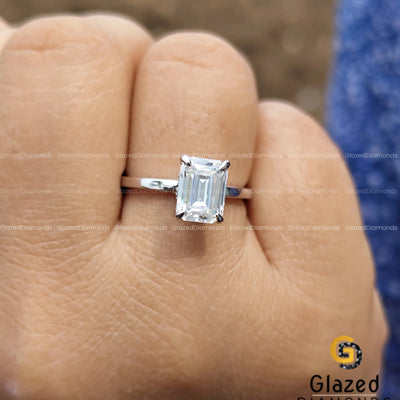
Yes. The marquise cut is one of the most flattering shapes for ring wear. The elongated body creates an optical illusion of length, making the finger appear more slender and defined.
The pointed ends direct the eye outward along the hand. Even at modest carat weights — around 0.75 to 1 carat — a marquise moissanite ring reads as a statement piece in a way that a round stone of the same size often does not.
Portrait photography and ring close-ups also favor the marquise shape. The elongated silhouette photographs with more visual drama than a circular stone. For buyers who want a ring that shows well both in person and online, marquise delivers.
Best Settings for a Marquise Moissanite Ring
The pointed tips of a marquise stone are the most structurally exposed part of the design. Setting selection directly affects protection, durability, and overall appearance.
V-Prong Setting The most common choice for marquise cuts. The V-shaped prongs sit flush against each pointed tip, securing the stone without covering it. Brilliance remains high and the tip is well-protected.
Bezel Setting A thin metal rim wraps around the full perimeter of the stone. This is the most secure option and gives a clean, contemporary look. It is a strong choice for buyers with active lifestyles.
Halo Setting Small accent stones surround the center marquise moissanite, increasing visual size and adding complexity to the design. This setting works especially well for buyers who want a bold, detailed ring.
East-West Setting The marquise stone is set horizontally across the band rather than vertically. This is a modern, architectural take on the shape that works particularly well in minimalist designs.
For full setting breakdowns by style, the types of moissanite engagement rings guide covers each option with context for different buyers.
Marquise Moissanite Size and Appearance Chart
Marquise moissanite has a larger face-up surface area relative to carat weight compared to round stones. This is one of its key practical advantages for budget-conscious buyers.
Approximate size equivalents (millimeters vs. diamond carat weight):
|
Dimensions (mm) |
Approx. Diamond Weight |
|
6 x 3 |
0.25 ct |
|
8 x 4 |
0.50 ct |
|
10 x 5 |
0.75 ct |
|
12 x 6 |
1.50 ct |
|
14 x 7 |
2.30 ct |
These are approximate equivalents. Moissanite weighs less per unit volume than diamond, so millimeter measurements are more useful for size comparison than carat weights.
A 12x6mm marquise moissanite visually competes with a 1.50-carat diamond at a fraction of the cost. For buyers who want a visually large center stone, the marquise shape in moissanite offers strong value.
To understand moissanite as a gemstone before selecting a shape, the complete moissanite overview covers its properties, grading, and buyer considerations.
Marquise Moissanite vs Lab Diamond
Both stones perform well in a marquise shape. The visual and practical differences come down to three factors: sparkle type, color behavior, and price.
Sparkle type: Moissanite produces more rainbow fire due to its higher refractive index. Lab diamonds produce cleaner, more neutral white light. Neither is objectively better — it depends on whether the buyer wants bold, colorful flashes or a more restrained, classic look.
Color in larger stones: At sizes above 1.5 carats, lower-grade moissanite can show subtle warmth or color tint under certain lighting. Colorless (D-F equivalent) moissanite minimizes this. Lab diamonds follow standard diamond color grading and do not exhibit this at comparable grades.
Price: Moissanite costs significantly less than lab diamonds of the same size. The gap has narrowed in recent years, but moissanite still offers a meaningful price advantage — particularly for larger center stones where the cost difference is most significant.
A full side-by-side breakdown is available in the moissanite vs lab diamond comparison.
Conclusion
The moissanite marquise cut delivers a larger visual stone, a flattering finger effect, and strong fire output — all at a meaningful price advantage over lab diamonds and natural stones.
The bowtie effect is rarely a concern with properly cut moissanite. Setting choice matters more with this shape than with round stones, and V-prong or bezel settings reliably protect the pointed tips.
Browse the full selection of moissanite engagement rings or explore all moissanite rings to find a marquise style that fits your design preference and budget.
For buyers who want to explore the full range of moissanite jewelry — from watches to chains and rings — Glazed Diamonds offers a curated selection built for buyers who value quality and sharp design without paying retail diamond prices.