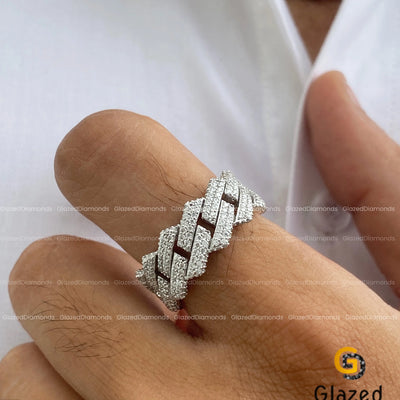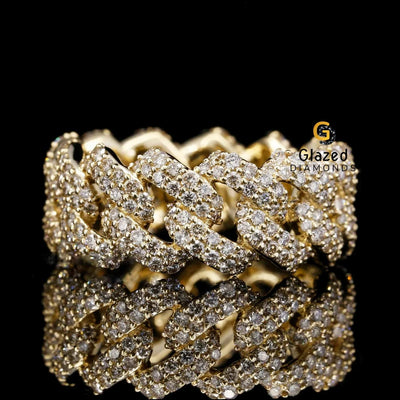


Moissanite is a genuine gemstone — composed of silicon carbide and ranking 9.25 on the Mohs hardness scale, second only to diamond. First identified inside a meteorite crater in Arizona in 1893, moissanite has a scientific origin that separates it from every other stone used in fine jewelry. Today, virtually all moissanite on the market is lab-grown, producing consistent, high-clarity stones at a fraction of the cost of natural diamonds.
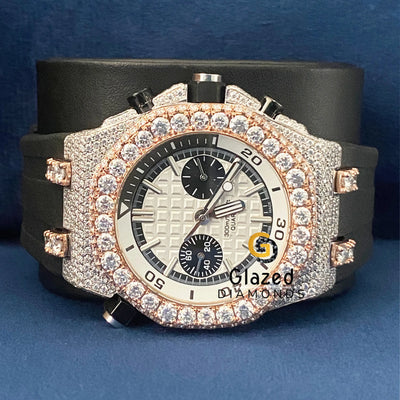
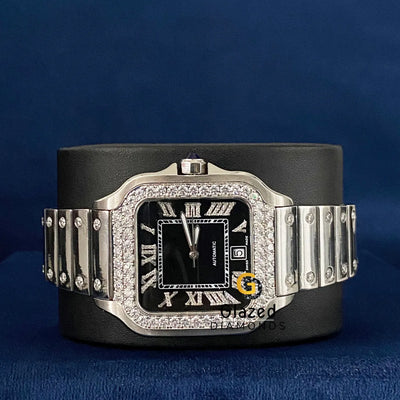
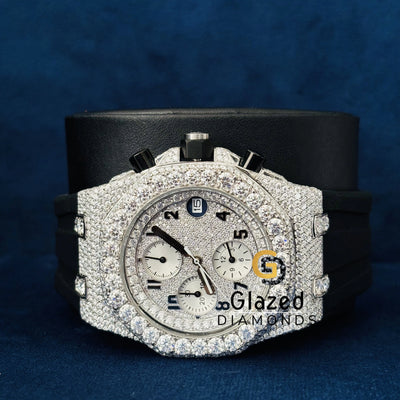
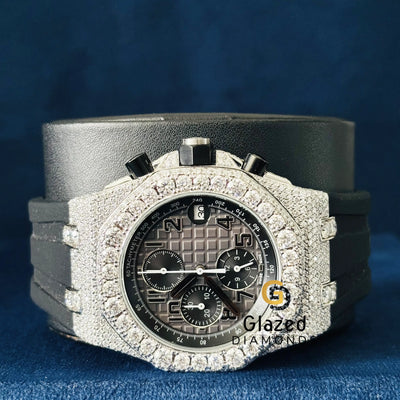
Its applications span across rings, chains, pendants, and iced out watches, where its superior brilliance performs especially well in multi-stone settings. This guide covers what moissanite is, its verified stone properties, its meaning in jewelry culture, and how it stands against diamond as a serious gemstone choice.
What Stone Is Moissanite?
Moissanite is a mineral made of silicon carbide, with the chemical formula SiC. In nature, it is extraordinarily rare — found only in meteorites and trace deposits deep in the Earth's upper mantle. Because natural moissanite exists in quantities too small for commercial use, all gemstone-quality moissanite available in the jewelry market today is produced in a laboratory.
French chemist Henri Moissan first identified the mineral in 1893 after discovering microscopic crystals inside a meteor crater near Canyon Diablo, Arizona. He initially mistook the crystals for diamonds. By 1904, further testing confirmed they were silicon carbide — a distinct mineral compound not previously found in nature. The gem was later named moissanite in his honor.
Natural moissanite has since been found in small quantities in additional locations, including the Green River Formation in Wyoming and as inclusions inside diamonds and kimberlite rock.
Correct Pronunciation of Moissanite
Moissanite is pronounced: MOY-suh-nite
-
Three syllables, with stress on the first
-
Phonetic spelling: /ˈmɔɪ.sə.naɪt/
Syllable breakdown:
-
MOY — rhymes with "boy"
-
suh — a soft, unstressed sound
-
nite — rhymes with "night"
Put together: MOY-suh-nite
If you want a detailed guide, check our correct pronunciation of moissanite guide.
Is Moissanite a Real Gemstone?
Moissanite is a real gemstone. A gemstone is defined as a mineral, rock, or organic material that is cut and polished for use in jewelry. Moissanite meets every part of that definition — it is a crystalline mineral with stable, measurable physical properties and established grading standards.
The fact that moissanite is lab-grown does not reduce its gemstone classification. Lab-grown sapphires and rubies are also accepted as real gemstones across the industry. Moissanite follows the same logic.
A common misconception in buyer research is that moissanite is a fake diamond or a synthetic imitation. Moissanite is not a fake diamond. It is a separate stone with its own unique chemical structure, optical profile, and performance data.
Moissanite Stone Properties
Moissanite's physical and optical properties are scientifically documented and consistently reproducible in lab conditions:
-
Hardness: 9.25 on the Mohs scale. The second-hardest gemstone after diamond (10), making it fully suitable for daily wear in rings, watches, and bracelets.
-
Refractive Index: 2.65–2.69, compared to diamond's 2.42. A higher refractive index means more light returns to the eye, producing stronger brilliance.
-
Dispersion (Fire): 0.104 — more than double diamond's 0.044. Moissanite produces intense rainbow flashes of light, particularly visible in larger stones and iced-out settings.
-
Thermal Conductivity: High enough that standard thermal conductivity testers register moissanite similarly to diamond.
-
Color Grading: Graded on the same D–K scale used for diamonds. Most commercial moissanite falls in the D–F colorless or G–I near-colorless range.
-
Weight: Approximately 10% lighter than a diamond of the same millimeter dimensions.
These properties make moissanite one of the most technically capable gemstones available for fine jewelry production.
Moissanite Gemstone Meaning
Moissanite does not carry a traditional birthstone designation or cultural symbolism in the way that stones like sapphire or garnet do. Its connection to meteoric impact sites has associated it informally with rarity and cosmic origin in modern jewelry culture.
In the USA luxury and hip-hop jewelry market, moissanite carries a more direct meaning — access to high-brilliance, high-impact jewelry without the price barrier attached to natural diamonds. For buyers focused on the visual weight and fire of a piece, moissanite delivers on every measurable metric a serious buyer considers.
Lab-grown production also positions moissanite as an ethically sourced stone. There is no mining involved, no supply chain ambiguity, and no environmental footprint comparable to earth-extracted diamonds.
Moissanite vs Diamond Gemstone
Moissanite and diamond are two distinct gemstones. Diamond is pure carbon, crystallized under extreme pressure deep within the earth. Moissanite is silicon carbide, formed under entirely different conditions.
The key factual differences between moissanite and diamond as gemstones:
-
Chemical Composition: Diamond = pure carbon. Moissanite = silicon carbide.
-
Hardness: Diamond = 10 Mohs. Moissanite = 9.25 Mohs.
-
Brilliance: Moissanite has a higher refractive index, producing stronger light return.
-
Fire: Moissanite produces more rainbow dispersion than diamond.
-
Price: Moissanite costs significantly less per carat than natural diamond at comparable sizes.
-
Origin: Diamond is earth-mined. Moissanite is lab-grown.
-
Detection: Standard thermal conductivity tests may not separate the two. Electrical conductivity tests will.
For a full breakdown of how these two stones compare across every metric, the moissanite vs diamond guide covers each difference in depth.
Moissanite is not inferior to diamond — it is a different gemstone with different advantages. The right choice depends entirely on the buyer's priorities.
Moissanite as a Diamond Alternative in Jewelry
Moissanite entered the commercial jewelry market in 1998. Its combination of hardness, optical performance, and price accessibility made it an immediate competitor to diamond in engagement rings. Over time, its use expanded into watches, chains, pendants, grillz, and full iced-out sets.
In the USA hip-hop and luxury jewelry market, moissanite is now a standard stone choice for high-visibility pieces. Moissanite rings set in gold deliver the same visual impact as diamond at a fraction of the investment. Moissanite bracelets and Cuban link chains with moissanite stones have become consistent sellers in the culture because the stone performs brilliantly in multi-stone pavé and bead settings.
Moissanite pendants and moissanite grillz also benefit from the stone's consistency — lab production means every stone in a matched set carries the same color grade and clarity profile, which matters in designs where uniformity across dozens of stones is required.
Why Moissanite Jewelry Is Growing in the USA
Three factors drive moissanite's growth in the USA jewelry market: price, consistency, and performance.
A one-carat natural diamond ranges from several thousand dollars to over ten thousand depending on grade. A moissanite stone at the same millimeter size delivers comparable fire and brilliance at a fraction of that cost. For buyers who want maximum visual impact — especially across iced-out pieces with hundreds of stones — the economics are straightforward.
Lab-grown production also guarantees consistent stone quality, which is critical for multi-stone settings where color and clarity need to match across an entire piece. This consistency is one reason moissanite has become the dominant stone in USA hip-hop jewelry production.
Glazed Diamonds carries a full range of moissanite jewelry — from watches and rings to chains, pendants, and grillz — shipped directly to the USA.
Please review the returns policy before purchase.
Conclusion
Moissanite is a scientifically verified gemstone with physical properties that compete directly with diamond on hardness, brilliance, and long-term durability. Its origin in a meteorite crater, its ethical lab-grown production, and its exceptional optical performance make it one of the most credible stone choices in the USA jewelry market today. The question is no longer whether moissanite qualifies as a real gemstone — the data answers that clearly. The real question for buyers is whether they want a stone that outperforms diamond on fire and brilliance while costing a fraction of the price.
Frequently Asked Questions
Is moissanite a real gemstone?
Yes. Moissanite is a real gemstone composed of silicon carbide, with verified physical properties and industry-standard grading.
What stone is moissanite?
Moissanite is a silicon carbide mineral, first identified in a meteorite crater in Arizona in 1893.
Is moissanite a natural stone?
Natural moissanite exists but is extremely rare. Nearly all moissanite used in jewelry today is lab-grown.
How hard is moissanite?
Moissanite rates 9.25 on the Mohs hardness scale, making it the second-hardest gemstone after diamond.
Does moissanite look like a diamond?
Moissanite closely resembles diamond but produces more rainbow fire and brilliance due to its higher dispersion rating of 0.104 versus diamond's 0.044.
Is moissanite a good diamond alternative?
Moissanite is one of the most technically capable diamond alternatives available, with comparable hardness, superior fire, and a significantly lower price per carat.
What is moissanite jewelry?
Moissanite jewelry uses lab-grown silicon carbide gemstones set in rings, watches, pendants, chains, and bracelets as a high-durability, high-brilliance option.