
Moissanite vs lab diamond fancy cuts is one of the most important comparisons to make before buying a non-round engagement ring. Both stones can look nearly identical in a round brilliant, but once you move to elongated and step-cut shapes, the differences in sparkle type, light performance, and overall character become noticeably more visible.
Fancy cuts — oval, pear, marquise, cushion, emerald, and radiant — each interact with light in their own way. That changes how moissanite and lab diamond each perform depending on which shape you choose.
What Separates Moissanite From Lab Diamond
The differences start at the chemical level.
Moissanite is made from silicon carbide. Lab diamonds are pure carbon. This difference in composition directly shapes how both stones handle light.
Moissanite has a refractive index of 2.65 to 2.69. Lab diamond sits at 2.42. The higher refractive index means moissanite bends light more aggressively, which produces more fire — the rainbow-colored flashes you see when the stone moves.
Moissanite is also doubly refractive. Light entering the stone splits into two rays. Lab diamond is singly refractive — one ray in, one ray out. This is the primary reason moissanite delivers more colorful sparkle while lab diamond delivers brighter white sparkle.
On the Mohs hardness scale, lab diamond scores 10. Moissanite scores 9.25. Both are durable for daily wear in any ring setting.
A full breakdown of moissanite vs lab diamond properties covers the complete comparison in detail.
Why Fancy Cuts Change the Comparison
Round brilliants are engineered to maximize fire and brilliance at the same time. Fancy cuts work differently. Elongated and step-cut shapes have larger, more open facets that expose more of each stone's optical personality.
For moissanite, larger facets make the double refraction and rainbow fire more prominent. For lab diamond, open facets showcase clean, white light return with strong clarity.
Neither is a flaw. The right choice depends on which kind of sparkle matches your preference.
The best cuts for moissanite guide explains how facet design affects moissanite performance across each shape.
Fancy Cut Comparison: Shape by Shape
Oval Cut
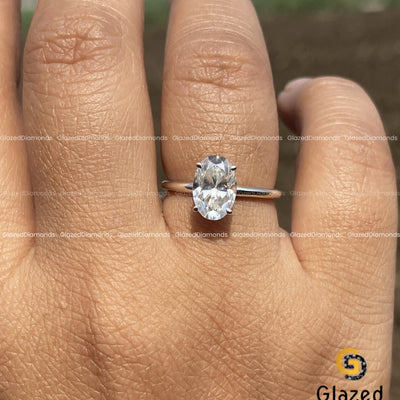
Oval moissanite delivers vivid fire and strong brilliance. The elongated shape maximizes moissanite's refractive index, pushing rainbow flashes across the facets. A well-cut oval moissanite also reduces the bow-tie shadow — a dark center zone common in elongated shapes — due to the stone's high light refraction.
Oval lab diamond produces brighter white light with less color fire. It faces up large for its carat weight, making it one of the most popular and cost-efficient fancy shapes for lab diamond buyers.
Both oval moissanite and oval lab diamond rank among the strongest performers in their respective categories.
Pear Cut
Pear moissanite can produce vivid sparkle, but cut quality is critical. A poorly proportioned pear moissanite may show a strong bow-tie shadow, especially in natural light. A precisely cut pear eliminates most of this issue.
Pear lab diamond faces up large per carat, delivers consistent white brilliance, and performs reliably across different lighting conditions. Details on faceting and light behavior are covered in the pear cut guide.
Marquise Cut
Marquise moissanite has pointed ends and intense fire. The double refraction in this shape is more visible than in round cuts. Under strong lighting, the rainbow sparkle is striking. Cut precision determines consistency across everyday lighting environments.
Marquise lab diamond delivers reliable white brilliance and faces up larger than almost any other fancy cut per carat weight — a real advantage for buyers who want visual size without a sharp price jump. See the marquise cut comparison for guidance on proportions.
Cushion Cut
Cushion moissanite is one of the best-performing fancy cuts for moissanite. The rounded corners and brilliant faceting work naturally with moissanite's optical properties. Cushion shapes also avoid the bow-tie risk common in elongated cuts.
One important distinction: brilliant cushion moissanite and crushed ice cushion moissanite perform differently in real-world lighting. The brilliant vs crushed ice moissanite guide clarifies which faceting style delivers better real-life performance.
Cushion lab diamond delivers clean, consistent white brilliance. It is a strong performer in all lighting and suits buyers who want reliable sparkle without dramatic color fire.
Emerald Cut
Emerald moissanite is a step cut. It produces a hall-of-mirrors reflection effect rather than fire-driven sparkle. The long parallel facets open up the interior of the stone. Double refraction in a step cut is more visible under magnification but is rarely apparent to the naked eye in a properly cut stone. The full emerald cut breakdown explains how facet geometry affects appearance.
Emerald lab diamond shows exceptional optical clarity and delivers clean, wide light flashes. For buyers wanting a sophisticated, understated look over high-fire sparkle, emerald lab diamond is the stronger choice.
Moissanite vs Lab Diamond Price in Fancy Cuts
A 1-carat moissanite typically costs $300 to $600. A 1-carat lab diamond costs approximately $1,000 to $3,000 depending on color and clarity grade.
Fancy cuts are generally priced below round brilliants for both stones, since less material is wasted during cutting. This means oval, pear, and marquise moissanite offer strong value for buyers wanting maximum visual size.
A 2-carat oval moissanite can cost less than a 1-carat oval lab diamond with comparable color and clarity grading.
The Moissanite Rainbow Effect in Fancy Cuts
Moissanite's fire comes from its dispersion rating of 0.104, compared to diamond's 0.044. This means moissanite splits white light into spectral colors more dramatically.
In fancy cuts, longer facets amplify this effect. For most buyers, this reads as exceptional sparkle. For buyers wanting a stone that closely resembles a natural diamond's optical output, the rainbow effect is worth evaluating before purchasing.
Understanding moissanite double refraction helps explain the full science behind this difference.
Which Stone is Better for Fancy Cuts?
Moissanite performs strongest in oval and cushion cuts. These shapes work with the stone's refractive properties to produce vivid, high-fire sparkle at a significantly lower price than lab diamond.
Lab diamond performs strongest in step cuts like emerald and Asscher. The optical cleanliness and white light return of a lab diamond reads well in these large, open-faceted shapes.
For buyers choosing a moissanite engagement ring, oval and cushion cuts offer the best balance of visual size, sparkle, and value. The full moissanite engagement ring and moissanite rings collection include multiple fancy cut options to compare.
Conclusion
Moissanite vs lab diamond fancy cuts comes down to sparkle type, visual goal, and budget. Moissanite performs best in oval and cushion cuts, delivering strong fire and larger visual size at a lower price point. Lab diamond is the stronger performer in step cuts like emerald, where optical clarity and white brilliance matter most. Both stones are durable, ethically sourced, and available in the full range of fancy shapes.
Explore the complete range of fancy cut moissanite styles at Glazed Diamonds.
FAQs
What is the best fancy cut for moissanite?
Oval and cushion are the best fancy cuts for moissanite. Both shapes work well with moissanite's refractive properties and produce strong fire without significant bow-tie shadow. These are also among the most popular shapes for moissanite engagement rings.
Does oval moissanite look different from oval lab diamond?
Oval moissanite produces more rainbow fire and vivid color flashes. Oval lab diamond delivers brighter white brilliance with more consistent light return across lighting conditions. The difference depends on whether you prefer colorful sparkle or clean white light.
Is pear moissanite a good choice?
Pear moissanite performs well in high-quality cuts. The bow-tie effect can be visible in lower-quality cuts, especially in natural light. Selecting a precisely cut pear moissanite from a reputable source significantly reduces this risk.
Is moissanite cheaper than lab diamond in fancy cuts?
Yes. Moissanite is significantly more affordable in all fancy cut shapes. A 2-carat oval moissanite can cost less than a comparable 1-carat oval lab diamond in most cases.
Does double refraction affect moissanite fancy cuts?
Double refraction increases fire in all moissanite cuts. In step cuts like emerald, the effect is slightly more visible under magnification but not noticeable to the naked eye in a properly cut stone. Brilliant-faceted fancy cuts like oval and cushion benefit most from moissanite's double refraction.
Which moissanite fancy cut looks most like a natural diamond?
Emerald cut and cushion cut moissanite tend to most closely resemble their natural diamond counterparts. Their faceting patterns moderate the rainbow fire effect compared to elongated brilliant cuts like oval or pear.