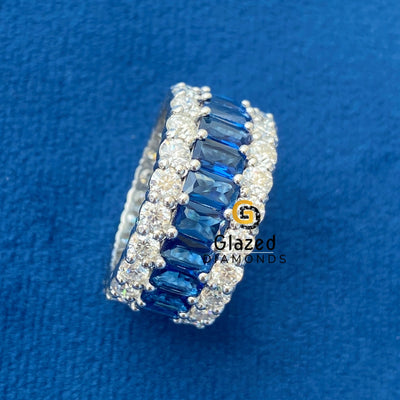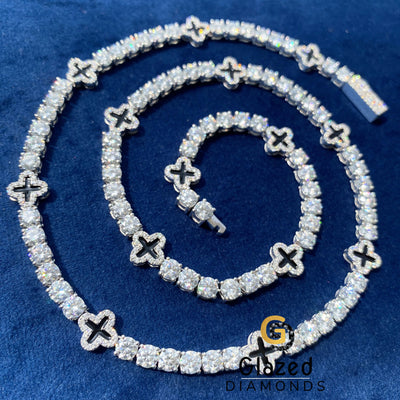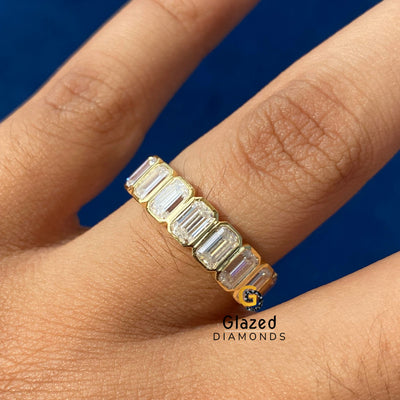

The GRA moissanite report fake vs real question matters more than most buyers think. Counterfeit certificates are a documented, growing problem in the moissanite market, and they are getting harder to detect with the naked eye. Whether you are shopping for a ring, chain, or one of the iced out moissanite watches that have become a staple in luxury streetwear, knowing how to verify a GRA certificate is not optional.
This guide covers what a genuine report looks like, the exact differences between a real and fake certificate, a step-by-step online verification process, and what to do if something does not check out.
What Is a GRA Moissanite Report?
A GRA moissanite report is an official grading certificate issued by the Gemological Research Association confirming a stone is genuine moissanite and documenting its quality across six measured parameters.
Those six parameters are:
-
Gemstone type — confirms the stone is moissanite, not CZ or another simulant
-
Carat weight — the measured weight of the stone, not an estimate
-
Cut grade — assessment of how well the facets interact with light
-
Color grade — D color is the highest grade, meaning fully colorless
-
Clarity grade — evaluates internal inclusions and surface characteristics
-
Laser inscription number — a unique serial engraved on the girdle of the stone
The report creates a traceable record. Every real certificate connects to a specific stone via that serial number. That traceability is the foundation of everything a buyer uses to verify authenticity.
For a foundational understanding of the stone itself, the what is moissanite guide covers the gemology in full detail.
Why Fake GRA Moissanite Reports Exist
Moissanite demand has grown significantly over the past decade. As the market expanded, so did the number of sellers willing to pair counterfeit or low-grade stones with fabricated certificates. A fake GRA report is engineered to give buyers confidence they have not earned.
The result for buyers who do not verify: they overpay for stones that do not match the claimed grade. Worse, some receive cubic zirconia or other simulants passed off as VVS D-color moissanite. The certificate looks professional. The stone looks similar. The price seems fair. By the time the buyer discovers the fraud, the seller is unreachable.
Fake certificates have become sophisticated enough that visual inspection alone is not sufficient. The GRA moissanite report fake vs real distinction now requires active verification, not assumption.
GRA Moissanite Report Fake vs Real: Key Differences
Paper and Print Quality
A genuine GRA report is printed on professional-grade bond paper. The stock has a weight and texture that standard printer paper cannot replicate. Hold the certificate at an angle under light. Real certificates typically carry a watermark embedded in the paper itself, not printed on top of it. Text throughout a genuine report is consistently spaced, uniformly sized, and crisp. Any blurring, misaligned sections, or inconsistent fonts are immediate red flags.
Hologram and Security Features
Authentic GRA certificates carry a holographic security seal. Tilt the certificate under direct light. A real hologram shifts color and reflects in multiple directions depending on the angle. Counterfeit certificates often substitute flat foil stickers that do not shift when tilted. A missing hologram entirely is an automatic disqualifier.
Serial Number and Database Match
Every genuine GRA certificate has a unique report number printed in the upper right corner. This number ties directly to a specific entry in the GRA verification database. On a real certificate, entering that number on the official GRA website returns exact matches for gemstone type, carat weight, color grade, clarity grade, and cut grade. On a fake, the number returns no result, a mismatch, or a database error.
Laser Inscription on the Gemstone
Many GRA-certified moissanite stones carry a laser inscription engraved on the girdle, the narrow outer edge of the gemstone. This inscription is the same serial number as the certificate. It requires a jeweler's loupe at 10x magnification or higher to read. A genuine inscription is sharp, evenly spaced, and matches the certificate exactly. Blurry, inconsistent, or mismatched engraving is a clear sign of fraud. No inscription at all does not automatically mean the certificate is fake, but it removes one layer of verification.
Seller Behavior
A seller offering genuine certified moissanite has no reason to withhold documentation. If a seller refuses to share the GRA report before purchase, delays sending it, offers only a low-resolution image, or cannot answer basic questions about the grading, treat that as a red flag. Reluctance is a tell.
How to Verify a GRA Moissanite Report Online
Verification takes under two minutes. These are the steps:
-
Locate the report number on your certificate. It is typically in the upper right corner.
-
Visit the official GRA website at gra-association.com.
-
Navigate to the certificate verification page.
-
Enter the serial number exactly as printed on the certificate.
-
Compare every detail the database returns against your physical certificate. Gemstone type, carat weight, color, clarity, and cut must all match precisely.
-
If the number returns no result, triggers an error, or shows mismatched data, treat the certificate as fraudulent until proven otherwise.
This single step eliminates the majority of fake reports in circulation. A counterfeit seller cannot plant a matching entry in the GRA's database. If the number does not verify, the certificate does not verify.
GRA vs GIA: Understanding the Difference
GRA (Gemological Research Association) and GIA (Gemological Institute of America) are completely separate organizations. They are not affiliated with each other.
GIA is the most globally recognized gemological authority. It grades natural diamonds, colored stones, and pearls. GIA does not grade moissanite.
GRA was established specifically to fill the moissanite grading gap. It uses comparable grading parameters to GIA (color, clarity, cut, carat) but operates as an independent body focused on lab-created and alternative gemstones.
When a moissanite certificate references GRA, that is the correct and expected credential for the stone category. A seller claiming GIA certification for moissanite is either uninformed or misleading, as GIA does not issue moissanite grading reports.
For buyers comparing stone options, the moissanite vs diamond breakdown covers the full property and value comparison.
Price Red Flags: What Real Moissanite Should Cost
Moissanite is already far more affordable than natural diamonds. A price that sits dramatically below market rate is a warning sign, not a deal. Counterfeit sellers use attractive pricing to bypass careful buyer evaluation.
General benchmarks for VVS D-color moissanite:
-
1 carat round stone: approximately $100 to $400
-
2 carat round stone: approximately $200 to $700
-
Moissanite watches, iced out: approximately $300 to $1,500 depending on stone coverage and movement
If a seller is offering a certified VVS D-color stone or a fully iced watch significantly below these ranges and attaching a GRA certificate to justify the quality, verify every aspect of that certificate before purchasing. The moissanite diamond cost guide provides current market pricing context for buyers doing comparison research.
Why This Matters for Moissanite Watches and Iced Out Jewelry
In the iced out watch market, GRA certification carries extra weight. A fully iced moissanite watch involves dozens to hundreds of individual stones across the case, dial, bezel, and bracelet. Without verified certification, there is no way to confirm whether those stones are genuine VVS moissanite, lower-grade moissanite, or cubic zirconia.
Buyers evaluating VVS moissanite watches need to apply the same verification process used for rings and loose stones. The certificate should specify the moissanite grade used across the piece, not just reference a single sample stone.
For buyers comparing stone performance between watch options, the moissanite vs diamond watch guide breaks down visual differences, durability, and price in practical terms.
Additionally, if you are purchasing a moissanite Cuban link chain or pendant, the same certificate verification rules apply. Any piece priced as VVS certified should be verifiable by serial number before money changes hands.
How to Physically Test a Moissanite Stone
When the certificate raises doubts, physical testing adds another layer of verification. These tests do not replace database verification, but they help.
Fire test. Moissanite has a dispersion value more than twice that of diamond, producing vivid rainbow-colored light flashes. Hold the stone under direct light and observe. Cubic zirconia produces significantly less fire. A stone showing only white sparkle with minimal color scatter may not be genuine moissanite.
Double refraction test. Moissanite is doubly refractive. Under a jeweler's loupe, look through the top of the stone toward the back facets. Genuine moissanite shows a slight doubling of the facet edges. Diamonds are singly refractive and do not show this effect. This property is unique to moissanite.
Diamond tester. A standard diamond tester will register moissanite as diamond because both stones conduct heat similarly. A moissanite-specific tester distinguishes between the two. If you have access to one, a genuine moissanite stone will register correctly.
For any significant purchase, an independent gemologist can conduct a professional assessment. The cost of an appraisal is modest compared to the cost of a fraudulent purchase.
Why Choose Glazed Diamonds for Certified Moissanite
Glazed Diamonds offers moissanite jewelry built for buyers who want documented quality at honest prices. The collection spans iced out watches, Cuban link chains, pendants, rings, and custom pieces, all with transparent product specifications. Please review our returns policy before purchase. Explore the full collection at Glazed Diamonds.
Conclusion
Most buyers never check. They see a professional-looking certificate, assume it is real, and move on. That is exactly what counterfeit sellers rely on.
Four checks, under five minutes: database verification, physical paper quality, hologram inspection, laser inscription match. Run all four before committing to any moissanite purchase. Genuine moissanite holds its brilliance, clarity, and hardness for life. A verified GRA moissanite report fake vs real test just confirms you are getting the stone the certificate promises.