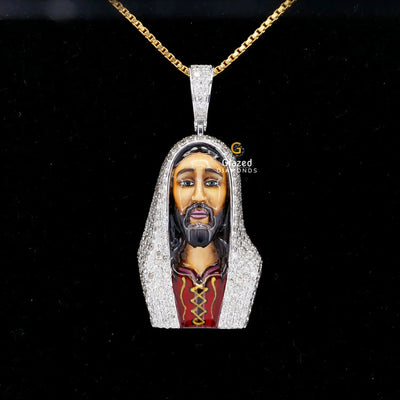



What is a bail in jewelry? It is the small metal connector that attaches a pendant to a necklace or chain. Without it, most pendants simply cannot be worn.
Whether you are picking out a piece from a moissanite pendant collection or building a full jewelry stack that includes iced out watches, knowing how a bail works helps you choose the right setup from the start.
This guide covers the definition of a bail, the most common bail types, and exactly what to look for when matching a bail to a pendant and chain.
What Is a Bail in Jewelry?
A bail in jewelry is the metal loop or connector piece at the top of a pendant that attaches it to a necklace chain. The chain passes through or clips onto the bail, which positions the pendant so it hangs flat and centered against the chest.
The word is sometimes spelled "bale." Both spellings refer to the same component.
Bails appear primarily on necklaces, but also on bracelet charms. They are made from metals including sterling silver, 14K or 18K gold, brass, and stainless steel. A bail does two things: it holds the pendant securely on the chain, and it controls how the pendant sits when worn.
Types of Bails in Jewelry
 Bail types differ based on how they attach to the pendant. Knowing the difference helps you match the right bail to the right piece.
Simple Loop Bail (Standard Bail)
The most common pendant bail type. It is a closed or semi-closed loop of metal. The chain threads directly through the loop, and the bottom of the loop connects to a ring on the pendant. Simple loop bails are minimal, clean, and compatible with most chain widths. Most fine jewelry pendants use this style.
Pinch Bail
A pinch bail has two small prongs that grip a top-drilled or side-drilled hole in a pendant or gemstone. No glue or soldering is required. The prongs are pressed together by hand or with flat-nose pliers to secure the stone. Pinch bails work well with briolette-cut stones, teardrop pendants, and flat pieces with a horizontal drill hole.
Snap-On Bail
A snap-on bail uses a hinge or tension mechanism to open and close without tools. It is the best option for interchangeable pendant setups, where the same chain holds different pendants depending on the occasion. Some snap-on bails use a magnetic closure. The pendant hole must be large enough to fit the bail loop when open.
Glue-On Bail
A glue-on bail has a flat textured pad at the base that bonds directly to the surface of a pendant using jewelry epoxy. This type is used for cabochons and pendants with no drilled hole. Two-part epoxy provides a strong bond when pressed firmly and left to cure. The textured surface improves adhesion.
Tube Bail
A tube bail has a hollow cylinder at the top that allows a cord or thick chain to pass through it. A ring at the bottom holds the pendant. Tube bails are most common in leather cord designs and wide rope chain setups. They work well for heavier pendants because the chain weight is distributed across the tube rather than a single loop point.
Peg Bail (Screw Eye Bail)
A peg bail has a small post that inserts into a half-drilled pearl or gemstone. The peg is glued in place with jewelry adhesive, and a jump ring is added to the top loop to connect it to a chain. Screw-thread versions provide a stronger hold than smooth-peg versions. This bail type is used most often with pearls and drilled round beads.
Bail vs. Jump Ring — Key Differences
|
Feature |
Bail |
Jump Ring |
|
Primary use |
Attaches pendant to chain |
Links components together |
|
Chain passes through? |
Yes, in most types |
No |
|
Controls pendant position? |
Yes, pendant hangs flat |
No |
|
Visible as part of design? |
Often, yes |
Usually hidden |
|
Best for |
Pendants meant to hang centered |
Charms, closures, connectors |
How to Choose the Right Bail for a Pendant
The right bail depends on the pendant's physical design and the chain it will be worn on.
Key factors to check:
-
Does the pendant have a drilled hole? If it has a top-drilled hole, a pinch bail or simple loop bail works. If it has no hole, use a glue-on bail.
-
Chain width: The bail opening must be wide enough for the chain to pass through. A narrow bail will not fit onto a thick rope or Cuban link chain.
-
Pendant weight: Heavier pendants need a sturdier bail, such as a tube bail or thick-gauge standard bail. A lightweight bail can bend or deform under heavy pendants.
-
Metal match: The bail metal should match or complement the pendant. A gold pendant paired with a silver bail creates a visual mismatch.
-
Style: If you want to swap pendants on the same chain regularly, a snap-on bail is the most practical option.
For custom Cuban link chain setups, a wide tube bail or heavy-gauge standard bail is the correct choice. Thick chains require a bail with an opening large enough to accommodate the chain links.
Bail Materials and Metal Finishes
The bail material affects both durability and appearance.
Common bail metals:
-
14K or 18K gold — used in fine jewelry, moissanite pendants, and diamond pieces
-
Sterling silver — popular in fashion and everyday jewelry
-
Stainless steel — corrosion-resistant, strong, widely used in hip hop and streetwear jewelry
-
Brass with plating — affordable, available in gold and silver finishes, used in fashion pieces
The finish also affects the final look. A polished bail reads more formal. A matte or brushed finish suits modern or casual styles. The bail finish should always match the pendant setting for a clean, cohesive look.
Bails in Custom and Hip Hop Jewelry
In custom iced out jewelry, bails carry heavier pendants set with moissanite or CZ stones. These pieces require bails built from thicker metal stock — typically 14K gold or high-grade stainless steel — to support the pendant's weight without bending.
The bail also affects the pendant's movement. A wide-loop bail allows the pendant to swing freely. A tighter-fitting bail keeps the pendant more centered and stationary.
For anyone exploring the wider world of custom jewelry, the moissanite grillz guide covers another category of moissanite custom pieces popular in the USA market.
Bails at Glazed Diamonds
At Glazed Diamonds, moissanite pendants are designed with bails that match the pendant's weight, chain width, and stone setting. Each piece is built to hang correctly and stay secure during daily wear.
The catalog covers moissanite pendants, chains, and full stacking setups, all shipped directly to the USA. For the full range of moissanite jewelry options, the all moissanite jewelry collection covers everything from pendants to rings to watches.
Conclusion
A bail is the connector that makes a pendant wearable. The type of bail that works best depends on whether the pendant has a drill hole, how heavy the piece is, and what chain it will be paired with.
Simple loop bails work for most standard pendants. Pinch bails are built for top-drilled stones. Snap-on bails suit interchangeable setups. Glue-on bails handle flat-backed pieces with no hole. Tube bails carry heavier pendants on thick cords or chains.
Get the bail right, and the pendant hangs exactly the way it should — flat, centered, and secure. Get it wrong, and even an expensive piece will look off. Most pendant shopping decisions focus entirely on the stone. The bail is the detail that actually determines whether the piece wears correctly.
FAQs
What is a bail in jewelry?
A bail is the metal connector at the top of a pendant that attaches it to a necklace or chain. It holds the pendant in position so it hangs flat and centered.
What is a bail on a necklace?
On a necklace, the bail is the piece located between the chain and the pendant. The chain passes through the bail, which keeps the pendant hanging at the center of the necklace.
What is the difference between a bail and a jump ring?
A bail holds the pendant and allows the chain to pass through it, controlling how the pendant hangs. A jump ring is a simple connector ring used to link components and does not position the pendant in the same way.
What type of bail is best for a heavy pendant?
A tube bail or heavy-gauge standard bail is recommended for heavy pendants. Both distribute the pendant's weight more effectively than lighter bail types.
What is a pinch bail used for?
A pinch bail is used for pendants or stones with a top-drilled or side-drilled hole. Its two prongs grip both sides of the drill hole to hold the piece securely without glue or soldering.
What is a hidden bail in jewelry?
A hidden bail is attached to the back of a pendant so the chain passes through it without the bail being visible from the front. It creates a cleaner look by removing visible hardware from the front of the piece.