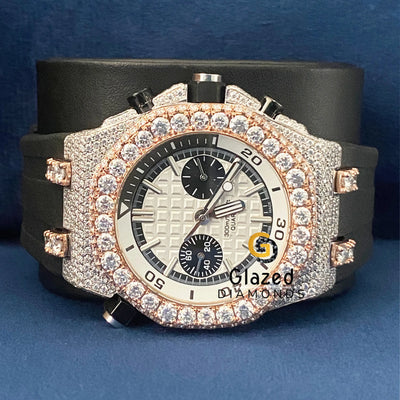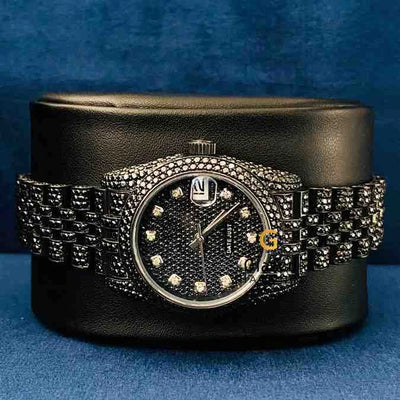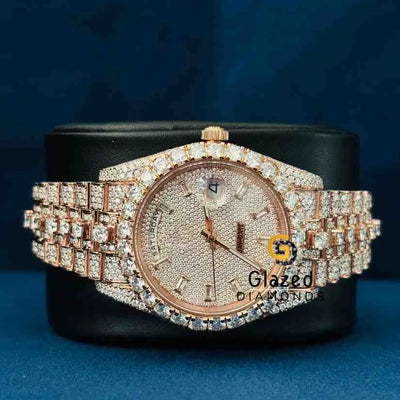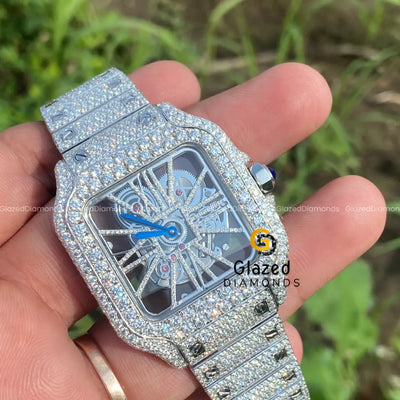


Blue diamond jewelry is rare by any measure. Only one in every 200,000 diamonds mined is classified as blue, making these stones some of the scarcest and most expensive gemstones in the world. Whether you're researching a blue diamond engagement ring, a pendant, or exploring the broader world of statement jewelry, this guide breaks down everything that matters — what makes a diamond blue, how the color is graded, what blue diamonds symbolize, the most famous stones in history, and how natural blue diamonds compare to other options. Buyers drawn to bold, light-catching jewelry also frequently explore iced out moissanite watches as a high-impact, accessible alternative to stones priced in the tens of thousands per carat.
What is Blue Diamond Jewelry?
Blue diamond jewelry refers to any fine jewelry piece — ring, necklace, earrings, bracelet, or pendant — set with a blue-hued diamond as the primary or accent stone.
A blue diamond is a natural fancy-colored diamond that exhibits a blue hue ranging from pale sky blue to deep vivid blue. Unlike sapphires, which are a different mineral entirely, blue diamonds are true diamonds with the same carbon crystal structure, a hardness of 10 on the Mohs scale, and the same refractive brilliance as any colorless stone. The blue color comes entirely from the presence of boron atoms in the diamond's crystal lattice, not from treatment or coating.
Blue diamonds are categorized under the "fancy color diamond" classification by the Gemological Institute of America (GIA). This category covers all diamonds that fall outside the standard colorless D-to-Z grading scale.
What Makes a Diamond Blue?
Blue diamonds are colored by trace impurities of boron within the crystalline lattice structure. As boron content increases, so does the intensity of the blue.
Most blue diamonds are Type IIb diamonds, making them electrically conductive — a property not found in other diamonds and one that adds another layer of scientific uniqueness to these stones. Type IIb diamonds account for less than 0.1% of all naturally occurring diamonds.
Secondary hues are common. Blue diamonds can carry gray, violet, or green undertones depending on their formation conditions. These secondary hues either add to or reduce the stone's value based on their intensity and balance relative to the primary blue.
How Blue Diamonds Are Graded
GIA recognizes seven color intensity grades for blue diamonds: Faint Blue, Very Light Blue, Light Blue, Fancy Light Blue, Fancy Blue, Fancy Intense Blue, and Fancy Vivid Blue — with Fancy Vivid Blue being the most saturated and commanding the highest prices.
Color is the single most important grading factor for blue diamonds. Clarity, cut, and carat weight still affect value, but a Fancy Vivid Blue at lower clarity will often outprice a higher-clarity stone with a weaker blue grade.
Natural Blue Diamond vs White Diamond
The most direct comparison buyers make is between natural blue diamonds and standard white (colorless) diamonds.
Rarity: Colorless diamonds are common relative to blue. Only one in every 200,000 diamonds mined is classified as blue. That scarcity is reflected directly in price.
Price: A 0.5-carat light blue diamond averages around $26,280. Deep blue and vivid blue diamonds cost significantly more — around $75,000 for a 0.25-carat stone. Colorless diamonds at the same carat weight cost a fraction of that.
Appearance: White diamonds prioritize colorlessness and brilliance. Blue diamonds offer a distinct color saturation alongside brilliance, making them a bolder, more visually commanding choice.
Investment: Natural blue diamonds can run ten times the cost of treated blue diamonds per carat. Collectors and institutional buyers treat top-grade natural blue diamonds as hard assets.
For buyers who want the bold, saturated look of a colored stone without the six-figure price point, moissanite rings set in premium metals offer comparable visual drama at a fraction of natural blue diamond pricing.
Types of Blue Diamond Jewelry
Blue Diamond Rings
Blue diamond rings are the most popular form of blue diamond jewelry. The center stone is typically set against white gold or platinum to maximize color contrast. Surrounding diamonds are usually colorless to keep focus on the blue center stone.
Ring settings for blue diamonds tend toward simple, clean designs — solitaire, halo, or three-stone arrangements. Overly ornate settings can compete with the color rather than complement it.
Blue Diamond Engagement Rings
Blue diamond engagement rings have grown in demand as buyers look for alternatives to the traditional colorless diamond. A natural blue diamond engagement ring is one of the most distinctive choices available in fine jewelry.
Accompanying gemstones in blue diamond engagement rings are generally softer colors to let the blue diamond shine, and these rings are most often set in high karat gold or solid platinum.
For couples who want the emotional weight and visual boldness of a colored stone without the blue diamond price point, moissanite engagement rings offer a compelling alternative. Please review the returns policy before purchase.
Blue Diamond Necklaces and Pendants
Blue diamond necklaces work best as solitaire or minimal settings that showcase the stone's color without distraction. A single bezel-set or prong-set blue diamond pendant on a fine chain remains the most effective design for maximizing the stone's color visibility at different lighting angles.
Pendant necklaces and stud earrings are popular ways to incorporate blue diamonds into a jewelry collection beyond rings. Buyers looking for a moissanite statement pendant can explore the moissanite pendant collection for pieces that deliver that same high-visibility sparkle.
Blue Diamond Earrings
Blue diamond earrings — most commonly studs — are the most wearable format for daily use. They offer a visible pop of color without the statement weight of a ring or necklace. Stud settings in white gold or platinum keep the focus on the stone's hue.
For a comparable look in moissanite, moissanite earrings deliver the same ice-forward appearance at a price point that reflects smart buying.
Famous Blue Diamonds
Several blue diamonds hold records in auction history and serve as reference points for understanding the category's upper ceiling.
The Hope Diamond One of the earliest mentioned blue diamonds is the Hope Diamond, a 45.52-carat fancy dark grayish-blue, believed to have been discovered in India. Its last owner was famed jeweler Harry Winston before he donated it to the Smithsonian National Museum of Natural History in Washington, D.C. The Hope Diamond has been on public display at the Smithsonian since 1958 and is valued at an estimated $250 million.
The Oppenheimer Blue The Oppenheimer Blue is a 14.62-carat vivid blue diamond that sold at Christie's in Geneva in May 2016 for $50.6 million, making it the largest Fancy Vivid Blue diamond classified by the GIA ever sold at auction. It is emerald-cut and classified as Fancy Vivid Blue — the highest color grade in the GIA system.
The Blue Moon Diamond The Blue Moon Diamond, weighing 12.03 carats, is one of the most vivid and flawless blue diamonds ever discovered. It sold at auction for $48.5 million.
The Mediterranean Blue The Mediterranean Blue is a 10.03-carat cushion-cut Fancy Vivid Blue diamond, discovered in 2023 at South Africa's Cullinan Mine. In May 2025, it sold at Sotheby's for $21.5 million.
These auction results confirm that top-grade blue diamonds are among the most consistently valuable gemstones on the market.
Are Blue Diamonds Real?
Yes. Blue diamonds are real, natural diamonds with a noticeable blue tone due to the presence of boron in the diamond's carbon structure. They are not treated or enhanced to achieve their color — they are found below the Earth's surface with their natural blue coloring.
There are, however, treated blue diamonds on the market. A more affordable alternative to a naturally blue diamond is an earth-mined diamond that has been treated with high-pressure, high-temperature (HPHT) to change its color to blue. These treated stones are real diamonds but are not natural blue diamonds, and their value reflects that distinction.
Always request a GIA certificate confirming the origin of the blue color before purchasing a blue diamond. The certificate will clearly state whether the color is natural or treated.
Where Natural Blue Diamonds Come From
Blue diamonds are found only in a few mines in the world: the Cullinan mine in South Africa, the Argyle Mine in Australia, and historically the Golconda mine in India.
The Cullinan mine near Pretoria, South Africa, is the single most consistent source of high-quality blue diamonds and is responsible for many of the stones that have set auction records. The Argyle mine in Australia, known primarily for pink diamonds, also produced blue diamonds before its closure in 2020. The Golconda region in India supplied the world's earliest documented blue diamonds, including stones that later became the Hope Diamond.
This extremely limited geographic distribution is a primary driver of blue diamond scarcity and price.
Moissanite as a Blue Diamond Alternative
Natural blue diamond jewelry is not accessible to most buyers. A single one-carat natural blue diamond at Fancy Vivid grade can reach six figures. For buyers who want the visual impact of rare, colored, high-brilliance stones, lab-grown moissanite has become the leading alternative across the jewelry market.
Moissanite scores 9.25 on the Mohs hardness scale, compared to diamond's 10 — making it genuinely durable for daily wear. Its refractive index is higher than diamond, meaning it produces more light dispersion and fire under the same lighting conditions.
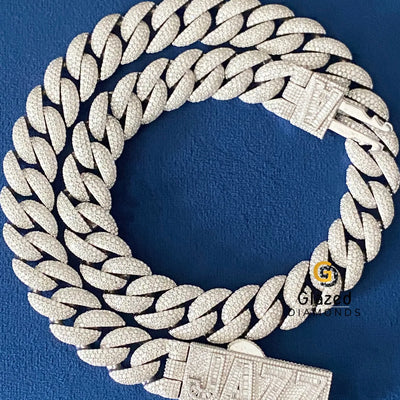
For statement jewelry buyers, the moissanite bracelet collection and Cuban link moissanite chains represent the same visual boldness that blue diamond collectors seek — without the auction-room price tags.
At Glazed Diamonds, the focus is on delivering that high-impact, ice-forward aesthetic through VVS moissanite pieces across watches, chains, rings, and pendants. Please review the returns policy before purchase.
Conclusion
Blue diamond jewelry occupies a category of its own in the fine jewelry world. The combination of extreme rarity, verified scientific distinctiveness, and centuries of cultural prestige makes natural blue diamonds some of the most coveted gemstones ever mined. Understanding how they're graded, where they come from, and what they symbolize gives buyers a clear framework for evaluating any piece that carries the blue diamond name.
For buyers drawn to the bold visual statement of rare, high-brilliance stones, moissanite continues to represent the most intelligent point of entry into that aesthetic — without the price barriers of natural fancy color diamonds.