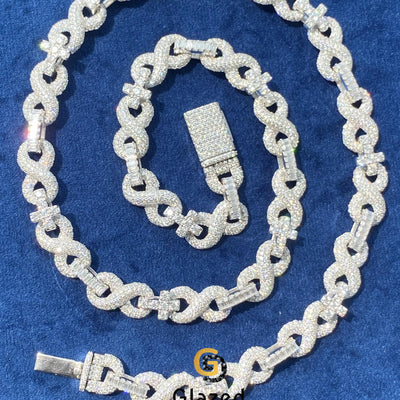



Types of chain clasps are one of the most overlooked decisions in jewelry buying. The clasp holds everything together — literally. Get it wrong and your chain pops open mid-wear, your pendant drops, or the mechanism wears out in months. Get it right and you barely notice it's there.
This guide covers every major necklace closure type, how each one works, what it's best suited for, and which clasp belongs on a Cuban link versus a rope chain versus a pendant build. If you follow Glazed Diamonds for moissanite watches and jewelry, this is the chain clasp knowledge that actually applies to what you're buying.
What is a Chain Clasp?
A chain clasp is the fastening mechanism that connects the two ends of a necklace or bracelet so it can be worn and removed. Every chain has one, but not every chain uses the same type.
Clasps differ in how they open, how secure they are under weight, and how they look against the chain itself. For heavy pieces like a gold Cuban link, clasp choice directly affects how long the chain lasts and how secure it feels daily.
Types of Chain Clasps
Lobster Clasp
The lobster clasp is the most common clasp in men's jewelry today. Named for its shape — it looks like a lobster claw — it uses a spring-loaded lever you push down to open, then release to snap shut.
Best for: Cuban link chains, rope chains, heavy pendants, everyday wear chains.
The lobster clasp is the standard on most moissanite Cuban link chains because it handles weight well and holds under movement. It's the most reliable all-purpose closure for men's chains.
Pros: Strong, durable, easy to use one-handed, available in multiple sizes.
Cons: Can feel bulky on very thin or delicate chains.
Spring Ring Clasp
The spring ring clasp is a small circular clasp with a spring-loaded lever inside the ring. Pull the lever back to open, release to close.
Best for: Lightweight necklaces, thinner chains, lower-price point jewelry.
Spring rings are the most common clasp on entry-level chains. They work fine for light pieces but wear faster than lobster clasps under daily use. The spring mechanism inside the ring degrades over time, especially with frequent opening and closing.
Pros: Small and discreet, inexpensive, widely available.
Cons: Harder to operate with one hand, wears out faster, not suited to heavier chains.
Box Clasp
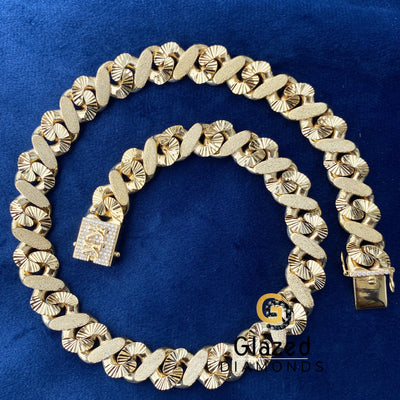
The box clasp uses a folded metal tongue that clicks into a decorative box housing. The tension of the fold holds it locked in place. Many box clasps also include a safety tab for extra hold.
Best for: Multi-strand necklaces, heavier gold chains, pieces where the clasp is visible and needs to look clean.
Box clasps are common on higher-end builds because the mechanism is sturdy and the finished look is neat. The clasp sits flush and blends into the chain rather than sticking out the way a lobster clasp can.
Pros: Strong, secure, clean look, often includes a safety latch.
Cons: Harder to replace if damaged, more expensive to manufacture.
Toggle Clasp
The toggle clasp is a two-piece closure: a bar on one end, a ring on the other. The bar inserts vertically through the ring, then lays flat horizontally to lock. The weight of the chain keeps it in place.
Best for: Decorative pieces, statement necklaces, chains where the clasp is part of the design.
Toggle clasps look good. That is their primary strength. They add a visual element to the chain rather than hiding. However, they rely on gravity and chain weight to stay closed, which makes them less ideal for men's chains for daily wear where a lot of movement is involved.
Pros: Stylish, easy to operate, visible design element.
Cons: Can open under heavy movement, bulkier than other clasps, not ideal for thinner chains.
Barrel Clasp
Also called a torpedo clasp or tube clasp, the barrel clasp is a cylindrical closure where two pieces screw or snap together. Both ends of the chain attach to the barrel halves, which then lock together.
Best for: Rope chains, heavy gold chains, thicker link styles.
Barrel clasps are a strong choice for rope chains specifically. The screw-lock version provides real security and sits cleanly against the chain without extra bulk. The snap-lock version is faster to use but slightly less secure than the screw version.
Pros: Secure, clean look, sits flush on thick chains.
Cons: Can be difficult to operate if the mechanism is small, screw versions require two hands.
Magnetic Clasp
A magnetic clasp uses two magnetized ends that snap together automatically. Align them close and they connect. Pull apart to open.
Best for: Lightweight chains, casual daily wear, buyers with limited hand dexterity.
Magnetic clasps are not the right choice for heavy gold chains or expensive pendants. They can weaken over time when exposed to strong magnetic fields, and they rely purely on magnetic force to stay closed — no mechanical lock. For a $500+ pendant, this is a risk worth knowing.
Pros: Extremely easy to use, fast to put on and take off.
Cons: Not secure under heavy load, can weaken over time, not suitable for heavier pieces.
Hook and Eye Clasp
One of the oldest clasp designs, the hook and eye consists of a curved metal hook that fastens into a fixed loop or ring. No spring mechanism. Pure mechanical tension holds it shut.
Best for: Vintage-style pieces, handmade jewelry, decorative chains.
Hook and eye clasps are not built for heavy daily wear chains. They can come undone if the chain is pulled. Where they work well is in decorative pieces that are not subject to constant movement or weight stress.
Pros: Simple, inexpensive, classic look.
Cons: Less secure than spring-loaded options, can open accidentally.
S-Hook Clasp
The S-hook is exactly what it sounds like: a small S-shaped hook that connects both ends of a chain. Both ends of the chain loop onto the S, and the tension of the chain holds the clasp in place.
Best for: Casual or decorative pieces only.
S-hooks are the least secure of all common clasp types. They are used mostly on costume jewelry or decorative pieces not meant for daily wear. Not a practical choice for any moissanite or gold chain.
Pros: Minimal, simple design.
Cons: Low security, can open easily under movement.
Chain Clasp Comparison Table
|
Clasp Type |
Security |
Ease of Use |
Best Chain Style |
Daily Wear Rating |
|
Lobster Clasp |
High |
Easy |
Cuban link, rope, heavy |
Excellent |
|
Box Clasp |
High |
Moderate |
Multi-strand, gold |
Excellent |
|
Barrel Clasp |
High |
Moderate |
Rope, thick link |
Excellent |
|
Spring Ring |
Medium |
Moderate |
Thin, lightweight |
Good |
|
Toggle Clasp |
Medium |
Easy |
Statement, decorative |
Moderate |
|
Magnetic Clasp |
Low-Medium |
Very Easy |
Lightweight, casual |
Moderate |
|
Hook and Eye |
Low-Medium |
Easy |
Vintage, decorative |
Low |
|
S-Hook |
Low |
Easy |
Costume jewelry |
Not recommended |
Which Clasp Is Best for Gold Chains?
For gold chains, the lobster clasp and barrel clasp are the two strongest options. Both handle weight without wearing down quickly, and both are available in gold-plated and solid gold finishes so the clasp matches the chain.
Gold chain clasp types matter more than most buyers assume. A thin spring ring on a heavy gold rope chain creates a weak point. The clasp is where most chain breaks happen. Matching clasp strength to chain weight is the single most important buying decision most people miss.
For yellow gold and white gold pieces, the lobster clasp is the most practical. Box clasps are the right call for multi-strand gold necklaces where visual cleanliness matters.
Which Clasp Works Best for Men's Hip-Hop Jewelry?
Most clasp guides are written for women's delicate jewelry. Men's hip-hop chains present a different set of demands.
A Cuban link, an iced-out chain, or a heavy moissanite pendant build puts real weight on the clasp. It's worn daily, often stacked with other chains, and moves with the body constantly.
The lobster clasp is the practical answer for most men's chains at every price point. For thick rope chains or Dominican Republic-style chains, the barrel clasp (screw-lock) is the stronger option. The toggle clasp can work on statement pieces but is not reliable enough for a daily-wear chain with pendant weight.
Magnetic clasps are convenient but should be avoided on any piece with real monetary or sentimental value.
Conclusion
The clasp on your chain is the smallest part with the biggest job. For Cuban links, rope chains, and any piece you wear daily, a lobster or barrel clasp is the right call. For decorative statement pieces, a toggle or box clasp adds to the look without sacrificing security. Avoid spring rings and magnetic clasps on any chain that carries real weight or real value.
Glazed Diamonds carries moissanite chains, pendants, and iced-out pieces built with proper closure hardware at every price point.